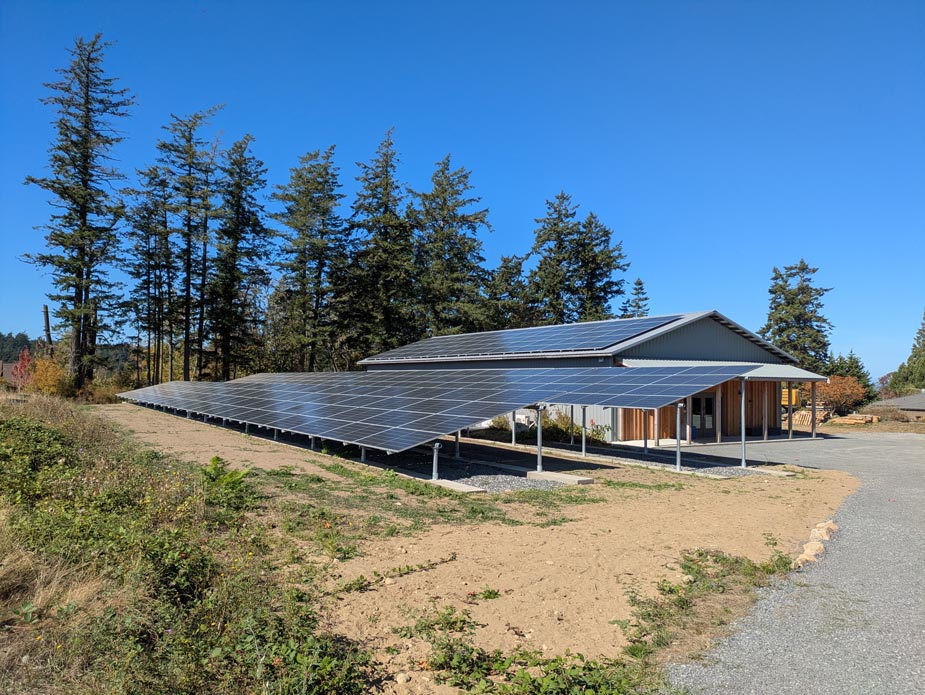
If the play’s the thing, then the Orcas Center is where you’ll catch the conscience of Orcas Island in Eastsound, Washington. More than a performing arts center, this community hub has served as an emergency hub during power outages and a resource center during the COVID-19 pandemic. The Orcas Center provides essential cultural and community services, and ensuring that the facility has robust grid backup and energy resiliency was a key motivator in the installation of a microgrid system that supplies 100 kW of solar power with a 1.3 MWh battery energy storage system (BESS).
- Developer: Cascadia Renewables
- EPC/Installer: Sulis Energy and Mills Electric
- Modules: Heliene
- Inverters: SolarEdge
- Storage: ELM MG2 and Hithium Cells
- Mounting/Racking: IronRidge
- Controller: ELM Fieldsight
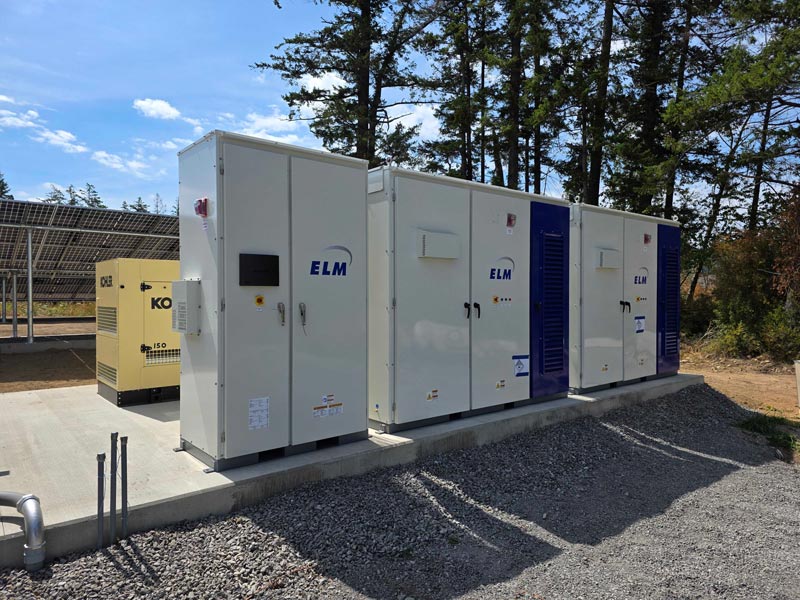
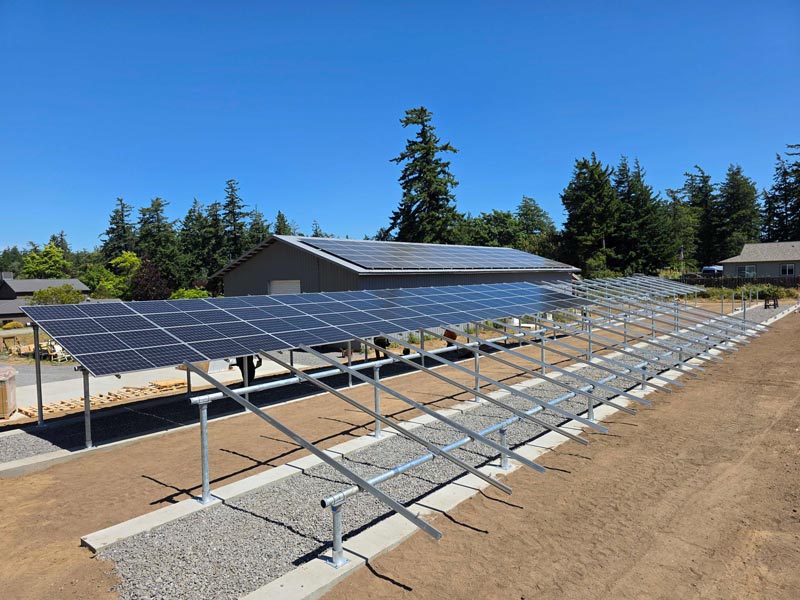
Developed by Cascadia Renewables, with Sulis Energy as EPC and Mayfield Renewables providing electrical engineering, permitting and construction support, the Orcas Center microgrid project integrates onsite solar PV, battery energy storage, and a diesel generator. An SEL grid isolation relay triggers a motorized breaker to island and reconnect the microgrid to the local grid. The generator provides supplemental power to backup loads and to charge the battery when at a low state of charge, while solar and grid power is unavailable. The team performed detailed hand calculations and developed synthetic load analyses to determine critical loads, system demands, and initial sizing for the battery energy storage system (BESS) and PV arrays.
Cascadia Renewables identified the need for an optimized, resilient system to sustain critical functions through extended grid outages, ultimately defining system requirements around peak demand and resiliency scenarios. Mayfield Renewables delivered full permit and construction sets for this new PV + BESS system that integrated with a 150 kW generator and supported relay coordination to isolate the microgrid and charge the BESS with the generator when at a low state of charge. Hurdles included the facility’s main breaker that required downsizing to enable a load-side connection, and the project had to adhere to strict equipment placement requirements per local and national fire codes.
Casting call
The project was the first to be developed and installed by Cascadia Renewables, which was founded in 2022, by managing partners Markus Virta and Callum McSherry, who also founded Sulis Energy in 2024 as their dedicated construction division. Orcas Center executive director Dimitri Stankevich reached out to Cascadia Renewables regarding energy efficiency and grant funding work at the facility.
“He [Stankevich] had been talking with a local solar installer about battery backup and enhanced resilience for the Orcus Center that played a really important role in emergency management during the COVID pandemic,” Virta says. “They were the vaccination hub for the island, and they became not only a designated mass care facility, but also a joint command center for the different authorities under the emergency management umbrella. And so, he was thinking more about what does it mean if we have a prolonged electrical outage at the facility, and how could they prepare to continue to provide those services for the community? He didn’t have a backup generator, and so he wanted to look into both the backup generator and as clean of a backup source of power as possible.”
After understanding the Orcas Center’s needs, Cascadia Renewables initiated the comprehensive solar + storage microgrid project, performing initial feasibility studies, securing critical grant funding, and subsequently managing the project implementation. Cascadia Renewables served as the project originator and technical lead.
Technical crew
The project crew overcame several hurdles during installation.
“The first is the fact that on the site as a whole, you had two different electrical services with different phases,” McSherry says. “To try and get the maximum benefit out of the system, we needed to combine the services, switch the phase of one of them, and really try and ensure that the site as a whole had as much flexibility in how it could be used in an emergency as possible.”
McSherry explains that Cascadia and Sulis overcame that challenge by working closely with the team at Mayfield and with the with the main electrical contractor.
“Mayfield Renewables was the electrical engineer of record for this project, and we got pulled in after equipment selection had happened,” explains Lucas Miller, senior engineering consultant at Mayfield Renewables. “Cascadia had already performed a preliminary analysis feasibility study for this project.”
The results of that were shared with Mayfield, and most of the firm’s work from that point onward was figuring out the best location for equipment, co-locating it where possible for
ease of maintenance and installation. Miller explains that Mayfield also performed a lot of work on controls coordination for the microgrid.
“This system has not one, but two electrical relays that need to communicate with each other dynamically in an islanded or non-islanded situation to control the dispatch of the generator bus and PV systems in real time,” Miller says. “A lot of our effort went into developing a construction and permit set, but also in coordinating with all the control partners involved in allowing these electrical resources to talk to each other to ensure that all the load is met at the Orca Center in an islanded scenario.”
Miller explains how the system works when the BESS falls below a certain state of charge.
“The generator will kick on, provide backup load to the facility and also recharge the battery without back feeding the grid and then turning off when the grid does come back on and ensuring that we’re not paralleling at any time between BESS and generator,” he says. “A lot of our efforts at Mayfield went into both locating the equipment, but then also helping all these vendors and controls programmers talk to each other and better understand the goals of the system.”
Another challenge for the project was the mounting system for the PV, McSherry adds. The project first attempted to use ground screws, which turned out to be a “risky proposition” on the remote island.
“In the event that you have a refusal of your ground screws, once you start working, there’s not a great deal you can do to get around that problem beyond re-engineering your mounting system as a whole,” McSherry says. “While we did our due diligence, we got the geotech reports and tests done, it did transpire that when we got out and started trying to install the system, seven out of seven grounds crews met refusal.”
The project team quickly re-engineered a solution to avoid a lengthy delay. With support from the project’s civil and structural partner, Facet Engineering, and speedy work from the civil contractor, Mammoth Construction, an alternate solution enabled the project to keep moving forward.
“Obviously, in a scenario like this, you’re working with a community that doesn’t have the resources to absorb a costly change order,” McSherry says. “Trying to figure out how to make those changes work within the budget and within the schedule of the grant was challenging. But again, I think there’s a lot of goodwill from all partners. Everyone understood the parameters we were working within and overcame that relatively smoothly and quickly.”