On the ski slopes, double black diamonds are for experts only. For a large utility-scale solar project in Illinois, it certainly took a high level of expertise to deliver a 593 MWac / 800 MWdc facility that will power 70% of Chicago’s city-run facilities, including major travel hubs like O’Hare and Midway airports. Other organizations including Cook County, CVS Health, Loyola University, PPG, State Farm and TransUnion are also sourcing power from the project via Constellation NewEnergy Inc.
- Developer: Swift Current Energy
- EPCs: McCarthy Building Co.
- Installers: Operating Engineers Local 12, Southwest Regional Council of Carpenters, Southern California District Council of Laborers and affiliated LiUNA Local 220, Electricians of IBEW Locas 428 and 357, Operating Engineers Local 12, IEW Local 47, Ironworkers of Locals 416 and 433
- Modules: First Solar
- Inverters: Sungrow
- Mounting/Racking: Nextracker (now Nextpower), Terrasmart
On the ski slopes, double black diamonds are for experts only. For a large utility-scale solar project in Illinois, it certainly took a high level of expertise to deliver a 593 MWac / 800 MWdc facility that will power 70% of Chicago’s city-run facilities, including major travel hubs like O’Hare and Midway airports. Other organizations including Cook County, CVS Health, Loyola University, PPG, State Farm and TransUnion are also sourcing power from the project via Constellation NewEnergy Inc.
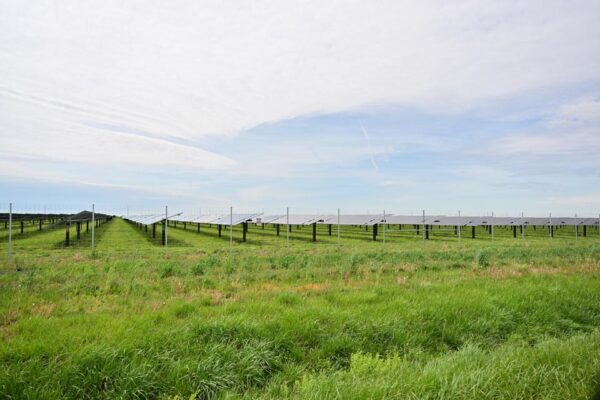
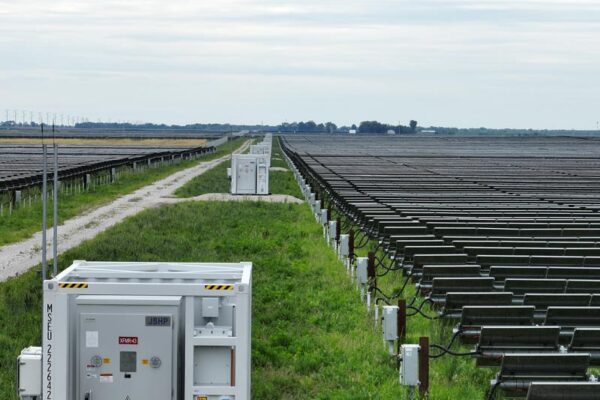
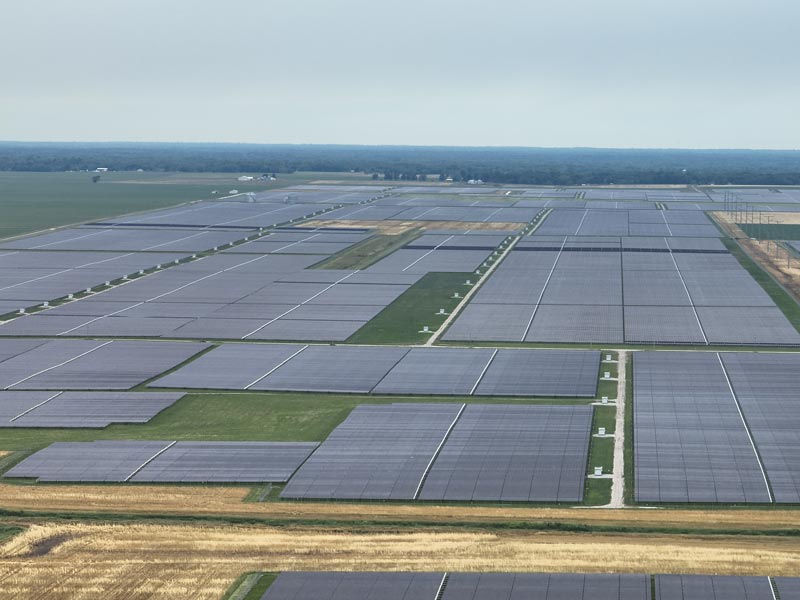
The Double Black Diamond Solar facility in Virdin, Illinois, provides a new energy source for the city of Chicago. Developed by Swift Current Energy, the project is the largest operating solar facility in Illinois and east of the Mississippi River.
McCarthy Building Companies Inc. served as the EPC for the solar project, finishing on time and on budget, while managing two installation methods to accommodate two types of solar modules. Plus, because of the size of the project, McCarthy used a phased approach to turn over operations to the developer to generate revenue as the project was being completed.
“The Double Black Diamond project, located in Central Illinois, really came about to fill a need for long-term, sustainable, competitive power generation in the region,” says Phillip Westerby, chief of project execution at Swift Current Energy. “This project, given its scale, the technology and the cooperation with Sangamon and Morgan counties, really made it a unique project. With this project, we’ve been able to fill a growing demand.”
Double modules
The Double Black Diamond project was initially designed for First Solar’s Series 6+ modules — a majority of which were domestically manufactured. However, upon the
release of the new Series 7 modules, built in Ohio, Swift Current opted to pilot the new modules for improved energy yield, lower degradation rates, and increased domestic content.
“Literally, months prior to finalizing an EPC contract with McCarthy and getting to go into the field, we had the opportunity to partner with First Solar,” Westerby says. “They brought up the opportunity where we could pilot their Series 7 technology, which did multiple things for us. It actually helped us increase the domestic content for the project, using U.S.-based materials, labor, equipment, etc. So that was highly valuable. It also helped to increase the energy density of the project with the higher wattage of the Series 7 modules.”
Westerby adds that the use of the new modules also led to increased partnership with other project partners, such as Nextracker (now Nextpower) to “lead the design of the tracker system to take the new format of the of the Series 7 modules.”
Ultimately, the project employed a 50/50 mix of the two modules, requiring that McCarthy adjust its installation plan to accommodate two different installation methods using different tools. In collaboration with Swift Current, McCarthy quickly adjusted its plan by developing and implementing a retraining strategy on site and comprehensively updating all Task Hazard Analyses (THAs) to accommodate for increased risks and safety concerns caused by the module mix. The strategy and adjustments were successful and yielded a combined total of more than 1.4 million labor hours with zero lost time incidents.
“We were the first EPC to install and commission a brand new technology,” says Brian Greenawalt, VP of preconstruction at McCarthy Building Companies. “That was an exciting challenge for us to take on it. Within the industry, though, module changes happen on every project. Just not maybe to this this scale.”
Phased operations
Given the size of the facility, McCarthy established a phased turnover approach to enable Swift Current to generate power and revenue before the facility’s entire completion, allowing the construction team to identify and resolve technical issues on a smaller scale and better allocate labor and resources. The team initially turned over half of the facility seven months early, followed by commissioning and turnover of 50 MW portions in the month that followed.
“As we were not only designing the project but also creating the final construction schedule, we realized that it was going to be extremely difficult to flip the switch,” explains Justin Peterson, senior VP of operations a McCarthy. “Just to turn on 600 MW of A/C power
all at once, we knew that was going to be a huge, huge hurdle. We also saw that because of the size of the project, we were going to have massive portions of it completed well before we were ready to turn on that last phase. And so, in collaboration with Swift, with Constellation, with all of the off-takers, we were able to develop a sequence and a schedule to energize and commission the plant in a sequence that matched their offtake needs.”
McCarthy ended up with 12 different circuits and seven different phases of the project that they were able to energize eight months earlier than originally anticipated.
Community support
The Double Black Diamond project provides significant returns to the community, generating substantial tax revenue for Sangamon and Morgan counties.
“Sangamon and Morgan counties alone over the life of the project will benefit over $100 million in revenues across the lifetime of the project,” Westerby says. “We had almost $800 million of investment for the project in the local communities to build the project. But also, we have community agreements that are on the order of $5 million that are going to local communities over the next several years that we’re excited about to be able to partner and support these communities and their in their local organizations.”
Through the project’s energization, Swift Current will contribute more than $10 million in community benefit funds to support the Sangamon Growth Alliance, Auburn School District, city of Chicago, and Cook County. Additionally, the project hired more than 430 local craft professionals, with many being first-time energy sector workers launching into new careers.
“We provided a lot of the hands-on training, helping them launch new careers right within the industry,” says Matt Jones, senior director of project management at Swift Current Energy. “We were a part of the IPA (Illinois Power Agency) and CEJA (Climate and Equitable Jobs Act), so being one of the first projects there that qualified, met and exceeded all the obligations to incorporate different types of labor force there that that otherwise wouldn’t have seen those. We created training facilities right at the local colleges. We brought in new training programs to the local unions. So you know many people were able to gain that experience, get that hands-on training and now are applying that to other projects around the country as well as locally. I think it was more than about generating electricity and building a power plant and where it was needed, but building more of a workforce that’s supported the local economies and really laid out a foundation for the future of the industry and those individuals.”