Don’t tell Gilman Brothers Co. that an old dog can’t learn new tricks. The 128-year-old, Connecticut-based family-owned and operated manufacturer of foamboard products took an innovative approach to solving its energy needs by installing a 750 kW rooftop solar system to lower energy usage and costs. But it was how the company approached the project that made it stand out.
- Developer/EPC/Installer: Budderfly
- Modules: Silfab
- Inverters: SolarEdge
- Mounting/ Racking: Unirac


Using an energy-as-a-service (EaaS) framework, the project’s developer, EPC and installer Budderfly helped Gilman Brothers achieve a 50% reduction in in electricity usage, reducing the company’s energy costs by up to 30% a year. In addition to the rooftop solar system, the $1.5 million project included upgrades to LED lighting, high-efficiency HVAC, and advanced controls. However, Gilman Brothers didn’t have to take on a huge financial risk to save on energy costs.
“We’re manufacturers of foamboard products for signs and displays that go into the retail environment,” says Cyrus Gilman, VP of Gilman Brothers, whose grandfather started the company in 1897. “The reason that we picked up this project is because our business is very energy intensive. We’re running a lot of heavy equipment for a small manufacturer. We’ve got 130 employees here, but our electric usage is very heavy. As we looked at our cost of doing business, we really felt like there was no way of reducing our electric bills, and our thought was to look towards solar.”
While the company didn’t have any experience with solar, they knew they had “a decent size rooftop here at the manufacturing plant” to house a PV system. In the process of researching solar, Gilman says the company learned about Budderfly and its EaaS model.
“It was very intriguing to us,” Gilman says. “We were under the impression that you basically go out and you pay whatever it is for a solar system. But under this new model that we discovered that is promoted by Budderfly, we realized that the benefits of not only not having to finance the project, but the fact that Budderfly would take control of our needs from one end to the other. In other words, over a 15-year contract, they would basically run the system for us, which in our mind was absolutely fabulous.”
Gilman Brothers was attracted to the fact that they didn’t have to use their resources to engineer the project and that Budderfly would be monitoring the system throughout the duration of the contract. It turned out to be the reason why Gilman Brothers decided to move forward with Budderfly on building the project.
Explaining EaaS
The innovation of the Gilman Brothers project lies not only in its technical merits but also in the way the partnership is structured. Through the EaaS approach, Budderfly takes on the project’s design, financing, installation, and long-term management, all at no cost to Gilman Brothers.
Through a 15-year agreement with Budderfly, Gilman Brothers was able to access all the associated benefits of solar while keeping its focus on core manufacturing. This approach helps energy become a managed service, not a constraint.
“The problem with the energy business is … to really bring energy efficiency, it takes heavy upfront investment, and people are unsure of the return on that investment,” explains Al Subbloie, founder and CEO of Budderfly, which is also a Connecticut-based company. “What we’ve done is create a technological platform through our billing that is able to do the measure and verify automatically as part of that investment. By doing so, we have a pretty good degree of predictability that if we’re going to invest X dollars, we’re going to be able to get that back over a period of time, and we bear the entire risk on that, which we should. We’re in the business, we understand the business and honestly we continue to manage and monitor that environment for the full 15 years.”
By using its technology platform and understanding the investment modeling, Subbloie explains that Budderfly is “able to unleash that capital” to make the necessary upfront investment to build a solar system. The result is a mutually beneficial business arrangement for the customer — i.e., Gilman Brothers — and Budderfly over the full 15 years of the EaaS agreement.
“It takes many, many years for us to break even,” Subbloie says. “But in the scheme of 15 years, if we do our job right, we can actually make money, which is important, so that we’re around for the long term.”
Innovative legacy
Adding solar isn’t the first time Gilman Brothers has found an innovative path toward solving its energy needs. In the 1920s, when water scarcity threatened the mill powering its
operations, the company’s founder created the Bozrah Light and Power Co. to secure energy independence for both the business and the surrounding community. Today, that same spirit of foresight is evident in embracing an energy model that ensures resilience.
While this energy innovation represents a century-long legacy for the company, Gilman Brothers views sustainability as a major part of its future.
“We want to portray to our customers that this company is moving in a direction where sustainability and environmental issues are of importance to us,” Gilman says, adding that the rooftop solar system is an example to the plastics manufacturing industry and the surrounding community.
“I’m just proud to see that hardware up on the roof and the quality of the installation, knowing that that is a step that we took along with Budderfly to innovate our company,” Gilman adds. “We’re known as innovators in our in our space, and honestly it just goes hand-in-hand with where we’ve been going and the direction of the company. Our employees love the fact that we are taking a lead in that direction.”
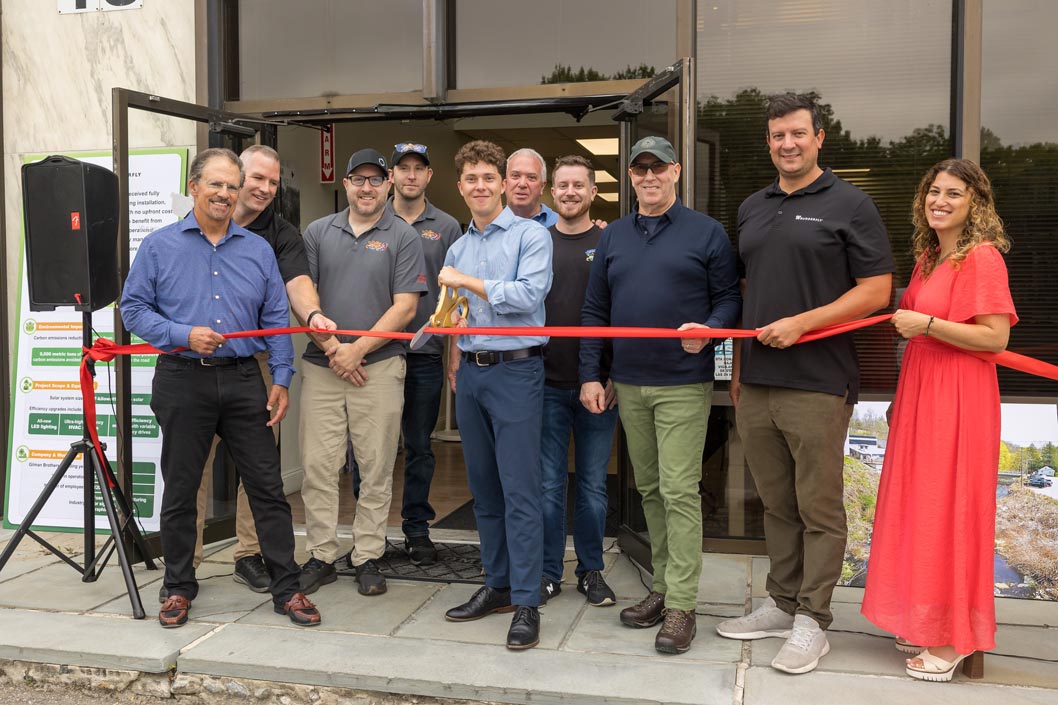
Gilman Brothers hosted a ribbon-cutting ceremony to celebrate the completion of the rooftop solar project, attracting local officials and community members.
“We’re in a small town, and I think it has a huge impact on our local neighbors looking at the Gilman Brothers Co., which has been here since 1897, as a leader in sustainability,” Gilman says.
In addition to serving Gilman Brothers, the project also helps to advance the state’s goal of 100% carbon-free electricity by 2040. For manufacturers, it demonstrates how solar projects can be implemented through innovative approaches and improve sustainability while also providing a pathway to long-term competitiveness in a rapidly changing economy.
“In the case of Gilman, my favorite part is the width of the portfolio of things that we did there and the achievement of cutting the energy use in half in terms of emissions says that we can do this and we can do it quickly and we have the money to do it,” Subbloie says. “There’s really no reason not to do it. Gilman is a leader in doing things. They’ve been in the energy business. Historically, a long time ago before we were all born and to have them take this leadership position, we’ve worked together with them to tell the world this can be done. You can have an impact and it’s a profitable thing for the business to do.”