Seeking a more sustainable way to power (and eventually expand) its operations, the Northern Cheyenne buffalo caretaking facility in Montana installed a 36 kW solar and 57.6 kW battery system that supplying much-needed energy reliability to the remote location.

- Developer: Indigenized Energy, Freedom Forever
- EPC/Installer: Freedom Forever
- Modules: Jinko Solar
- Inverters: Jinko Solar
- Storage: Jinko Solar
- Mounting/Racking: Nuance Energy Osprey Racking
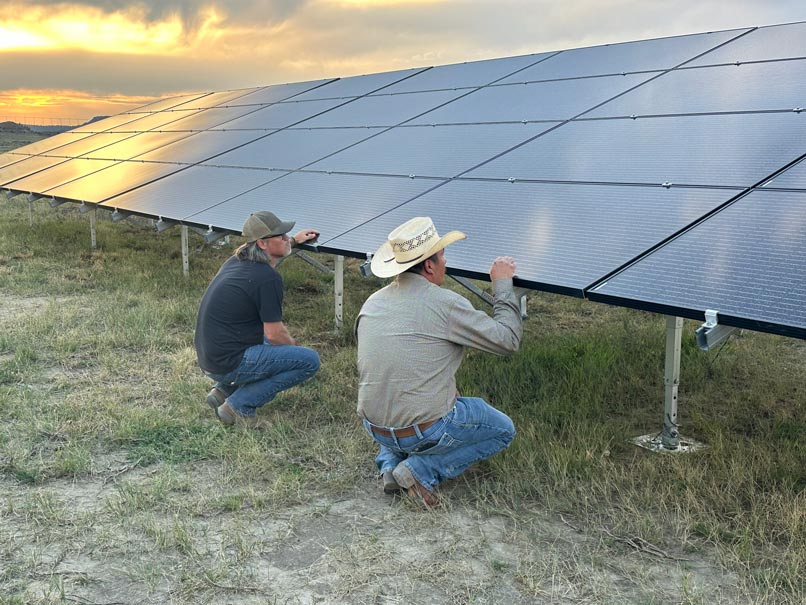
This fully off-grid PV and battery system powers the operations for a remote buffalo caretaking facility on the Northern Cheyenne Reservation near Ashland, Montana, providing reliable, emissions-free electricity to a culturally significant location with no grid access. While the remote location presented several logistical challenges, the successful installation allowed the community to replace a diesel generator to improve sustainability.
The project was developed and installed by Freedom Forever in collaboration with Indigenized Energy, a Native-led nonprofit that seeks to advance tribal energy sovereignty. Additionally, Jinko Solar donated some of the equipment and materials used on the project.
Expanding possibilities
The new solar and storage system will allow the buffalo management facility to expand its operations and double the size of the herd, according to Brandon Small, manager of the Northern Cheyenne Reservation buffalo facility.
“We’re close to 400, a 394 or 395, so if we doubled, it’s going to be right around 800, which is kind of our ideal size,” Small says. “We were pushing for 1,000, but I don’t think we have enough pasture for that yet. Maybe in a few more years when some of the cattle operators decide to retire. Maybe then we can pick up some more pasture and keep growing.”
By doubling the number of buffalo, the facility will also be able to double its harvest.
“This year we are harvesting 55 animals, with the amount of Buffalo we have now and then we’re donating that back out to the community,” Small adds. “Now, we’re going to have the capacity to expand our herd, so we’re looking at maybe doubling our herd size and being able to harvest 100 animals a year and donate that all back out to the community.”
Building the solar and storage facility allows the Norther Cheyenne Reservation to improve energy sovereignty and sustainability for a culturally significant practice, according to Cody Two Bears, founder and CEO of Indigenized Energy, which helped provide funding for the project.
“The project out there in Northern Cheyenne and Montana based around the buffalo is really of significant importance,” he says. “Why I say that, in the northern plains and all the tribes in the northern plains, buffalo was really their way of life. It was their way of economic value. It was the way of really being sustainable.”
Two Bears explains that the native tribes in the northern plains are seeking to regain a connection with the buffalo that was lost.
“What we’re seeing with climate change and what we’re seeing with the environment around us, as we’re trying to save our Buffalo, we’re also trying to save the environment,” he says. “But to be able to do that work hand in hand, I think why this project was really significant was because there’s no power in a lot of these remote areas, especially within their buffalo program there in Northern Cheyenne and Montana. There were no utility lines that went anywhere in the area or where their buffalo roamed. But there was a lot of need out there to be able to run their buffalo program.”
The collaboration between renewable energy and the tribe’s buffalo program provides a sense of empowerment for the community.
“I always say this is like food sovereignty along with an empowerment for a people that’s really trying to move forward in a in a way that really is sustainable at all levels. It is really a proud example of what can be done, not just with food sovereignty, but energy sovereignty in general with this off-grid system.”
In designing and the off-grid solar and storage system, Freedom Forever worked hand-in-hand with Indigenized Energy and Small to understand the day-to-day needs of the buffalo facility and what the system would be powering, according to Craig Ells, senior electrical applications engineer at Freedom Forever.
“Bringing his team in, they needed internet out there,” Ells says. “They needed to have the ability to get in and out of the climate. In the summertime, it gets extremely hot out there, but then in the wintertime, it gets extremely cold. One of the things that was built during this project was also a shed for them to have a place to get out of those elements, so that was one of the things that was electrified during the process.”
Another significant part of the project was the buffalo shoot.
“The buffalo shoot is where they’re helping to process the animals so that they can look at this from a vet to come in and check them out,” Ells says. “But the buffalo chute was about 250-300 feet away, so we had to do a lot of trenching to different locations.”
In addition to powering the new building, the project team also brought in refrigerators, freezers, indoor and outdoor lighting, heating and cooling, and storage for tools and equipment. Plus, Ells adds that the system was designed with future expansion in mind, providing enough capacity to power an additional building “that they’re hoping to build in the coming years.”
Remote wranglings
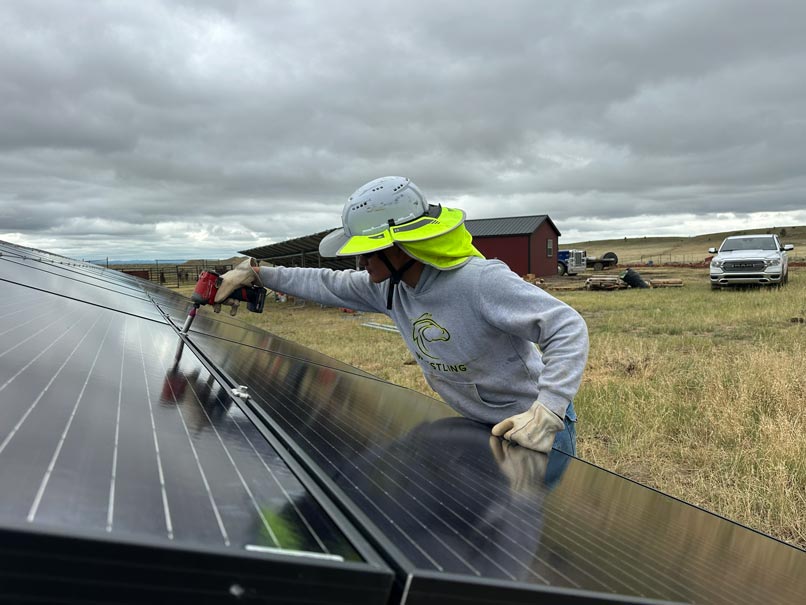
Overcoming the challenges of the remote location was a major hurdle for the project team, according to Devyn Waitt, tribal program manager at Freedom Forever. The supply deliveries were especially anxiety-inducing.
“We had GPS coordinates, but with the GPS coordinates, it’s a little bit like you kind of have to know where to go,” Waitt explains. “For example, there was a funny tree that was my marker for how I got to where we were going. But that was kind of difficult to communicate to long haul drivers, and so it definitely posed a challenge in terms of getting the material to the site. On top of that, it was a really long dirt road to get out to where the pasture was, and when it rained, it became incredibly muddy, and so we had just some challenges with getting our crew out there.”
The project team started using a shuttle system for the crew, to allow only the best equipped vehicles on the dirt road to the installation site. However, despite this careful coordination, a heavy rainstorm almost derailed the project.
“We had a local builder create this shed, and we needed to get that down this road,” Waitt says. “And of course, the night before, it absolutely poured. There was a moment where we’re like, ‘Oh my gosh, we’re going to have to put off the delivery.’ But he couldn’t come back for 10 days, which would have put us totally behind schedule and over budget.”
Unsure of what to do, Small and his team at the buffalo facility jumped into action.
“They were so helpful and hands-on, learning the whole time we were building the system,” Waitt says. “When that road was all muddy, they were just like, ‘We’re going to do this.’ And they got their grader and all morning as the shed is in route being delivered, they were just pushing this mud off the road. We were looking at the sun like, please dry it. It was definitely a tense day.”
After navigating the slippery terrain, the tractor-trailer had to squeeze through a gate with only inches to spare on each side. Waitt credited the onsite collaboration for the project’s success.
“There was kind of that elated feeling because there were so many organizations partnering on this,” she says. “We had the team from Indigenized Energy there, Brandon and his crew, the Freedom Forever team, the builder. I feel like it was successful because everyone combined put their heart into it and were like, ‘We believe this is going to work.’”
Two Bears expands on the collaborative effort on the project.
“Indigenized Energy led the development in this area. Freedom Forever served as the project coordinator, just making sure that things got done. But we also got some of the equipment donated by Jinko Solar,” Two Bears says. “Jinko Solar has donated us a significant amount of panels to Indigenized Energy to do a lot of this work. And of course, we couldn’t have done it without two funding partners along with Indigenized Energy that helped fund this project, the Hanold Foundation and Empowered by Light. It was a really a collaborative effort between all of us to make this project possible and to make it a success.”
Community impacts
The installation of the off-grid solar + storage system has had significant impact on the Northern Cheyenne Reservation beyond just powering the buffalo management facility.
Three of the installers on the project were Northern Cheyenne tribal members who have now become full-time traveling employees with Freedom Forever, hired because of training provided during previous Department of Energy projects on the reservation.
The project has created meaningful career opportunities while building local technical expertise. Beyond powering the processing chute, the newly conditioned shed eliminates the need to trailer equipment to the remote site daily, including four-wheelers used to herd the buffalo. The project directly supports cultural restoration efforts, as healthy buffalo populations restore grassland ecosystems and strengthens the sacred connection between the Cheyenne people and buffalo.
In addition, the project facilitated sustainability training. Partnering with Jinko Solar, the project team provided comprehensive operations and maintenance training, ensuring the buffalo crew will be able to independently manage their energy system long-term.