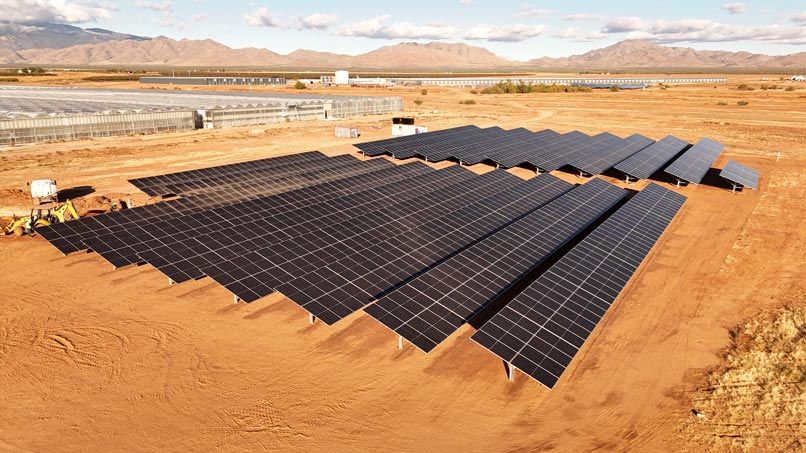
Talk about renewable energy. The 4 MW Willcox Greenhouse solar project helped an agricultural company reopen a dormant growing facility and bring back hundreds of jobs to the southeastern Arizona community.
- Developer: EnPower Star
- EPC: Obodo Energy Partners
- Installer: Obodo, Icon Electric, Sunstall, and Rubicon
- Modules: Canadian Solar
- Inverters: CPS | Mounting/Racking: OMCO Solar
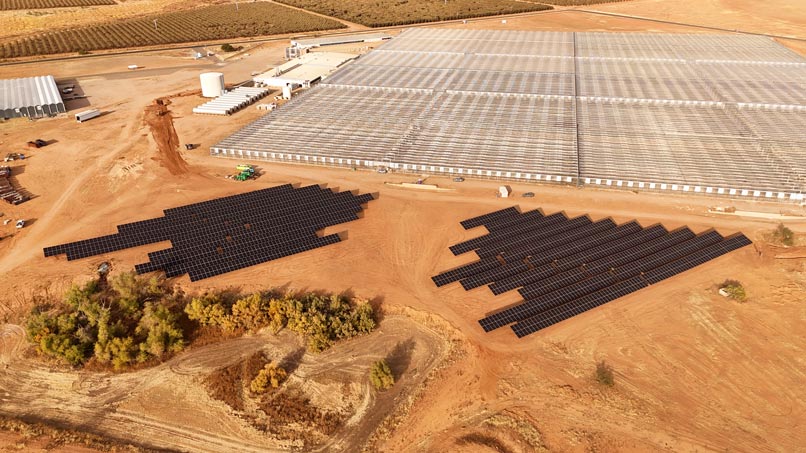
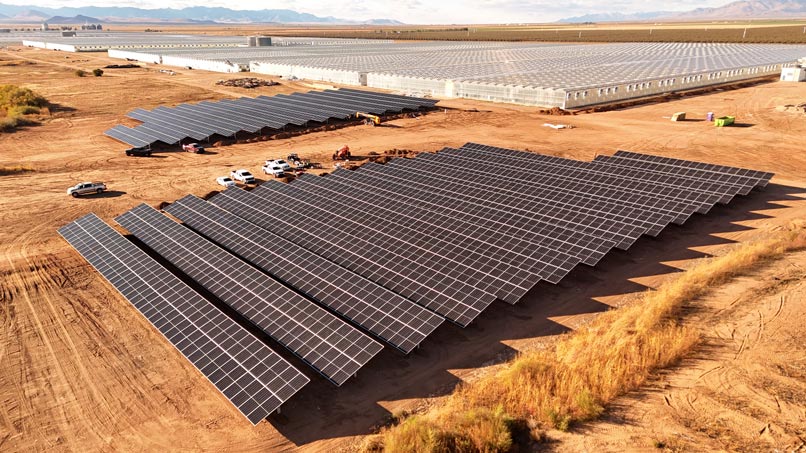
Developed by EnPower Star, with Obodo Energy Partners serving as the EPC partner, the C&I ground-mount solar project comprised three sites and five utility interconnections to power a large commercial greenhouse operation in Willcox, Arizona. The project overcame several challenges, including late-stage redesigns and construction obstacles, but the solar installation helped the project owner reopen a facility that had been closed since the COVID-19 pandemic and a tomato blight in 2020.
The project advanced from contract signing to permission to operate in less than 90 days. Delivering that scale on such a timeline required exceptional coordination and communication between the owner, developer, local utility (Sulfur Springs Valley Electric Cooperative), AHJ (Graham County), general contractor, engineering teams, and subcontractors.
“The owner of the greenhouses had owned a much larger organization and actually had a fairly significant tax burden,” says John Mitman, founder and CEO of Obodo Energy Partners. “When they acquired this property and were looking to relaunch greenhouse operations, they were looking to try to reduce their operating expenses but also leverage the tax equity component of it. In a way, it was kind of like an owner self-development approach.”
Industrial ballet
The property involved in the project included 11 greenhouses that were each 100,000 square feet. The facility had been dormant for about five years since COVID shut down the prior operation.
“It’s a really exciting project that the primary goal was focused on trying to put a system in quickly,” Mitman says. “We had to get it done by the end of 2024 to get the tax equity commercial operation date finalized. And to be honest with you, it was a small miracle that all of it came together and certainly a team effort.”
Although the multiple sites of the project posed a challenge to build the project, the upside was having plenty of space.
“The multiple sites certainly added some complexity,” says Chris Mejia, partner and chief development officer at Obodo Energy Partners. “I would say one of the things that really benefited us was that we had a large amount of empty land that we could use. We weren’t constrained as we would have been in an urban environment.”
The open spaces allowed the project team to easily move from one site to the next.
“That was a great assist to our production crews,” Mejia says. “We were able to sequence this project in such a way where we were able to move, starting with the grading and the ground preparation, and then move into the pilings and the racking systems, and then move from site to site. The scheduling and the sequencing there was kind of like a ballet in an industrial sense.”
Developed by EnPower Star, with Obodo Energy Partners serving as the EPC partner, the C&I ground-mount solar project comprised three sites and five utility interconnections to power a large commercial greenhouse operation in Willcox, Arizona. The project overcame several challenges, including late-stage redesigns and construction obstacles, but the solar installation helped the project owner reopen a facility that had been closed since the COVID-19 pandemic and a tomato blight in 2020.
The project advanced from contract signing to permission to operate in less than 90 days. Delivering that scale on such a timeline required exceptional coordination and communication between the owner, developer, local utility (Sulfur Springs Valley Electric Cooperative), AHJ (Graham County), general contractor, engineering teams, and subcontractors.
“The owner of the greenhouses had owned a much larger organization and actually had a fairly significant tax burden,” says John Mitman, founder and CEO of Obodo Energy Partners. “When they acquired this property and were looking to relaunch greenhouse operations, they were looking to try to reduce their operating expenses but also leverage the tax equity component of it. In a way, it was kind of like an owner self-development approach.”
Industrial ballet
The property involved in the project included 11 greenhouses that were each 100,000 square feet. The facility had been dormant for about five years since COVID shut down the prior operation.
“It’s a really exciting project that the primary goal was focused on trying to put a system in quickly,” Mitman says. “We had to get it done by the end of 2024 to get the tax equity commercial operation date finalized. And to be honest with you, it was a small miracle that all of it came together and certainly a team effort.”
Although the multiple sites of the project posed a challenge to build the project, the upside was having plenty of space.
“The multiple sites certainly added some complexity,” says Chris Mejia, partner and chief development officer at Obodo Energy Partners. “I would say one of the things that really benefited us was that we had a large amount of empty land that we could use. We weren’t constrained as we would have been in an urban environment.”
The open spaces allowed the project team to easily move from one site to the next.
“That was a great assist to our production crews,” Mejia says. “We were able to sequence this project in such a way where we were able to move, starting with the grading and the ground preparation, and then move into the pilings and the racking systems, and then move from site to site. The scheduling and the sequencing there was kind of like a ballet in an industrial sense.”
Interconnection intrigue
Designing the interconnection for the three solar sites required some design engineering magic.
“This whole site is fed by a utility substation, but there are 11 independent greenhouse operation buildings there,” Mitman says. “What we ended up doing was we figured out a way to interconnect to five of the metered services. The utility company was really interested in taking over ownership of the transformers, whereas before it was all held by the ownership group that had the land.”
In a rare move, Obodo Energy negotiated for permission to connect to the utility transformers directly, says Mitman, adding that most interconnection agreements don’t allow that.
“For five independent interconnections, we had to scale them properly to offset each of the individual loads,” Mitman explains. “Ultimately, I was going back to a totalized meter at the substation. It was just kind of working the magic between all the different sites to try to get that total build out in place as efficiently and as consistently as possible.”
Design changes
The project faced several unexpected challenges. Late in development, design changes were required to accommodate future battery storage and to resolve questions of transformer ownership.
During construction, site walks revealed major obstacles in areas already designed for solar arrays. At Site 1, a trash pit filled with broken glass from past greenhouse operations was discovered under part of the planned northern array. This required a rapid redesign to ensure safety and maintain construction integrity. At Site 2, crews uncovered buried netting and unexpected drainage issues near a water channel, which made heavy grading equipment unusable.
“In the middle of the day, at the very beginning of the project, we had to quickly pivot and find an alternate solution there,” Mejia says. Within days, the team redesigned layouts, shifted trenching routes, and adapted to the new terrain. Each challenge demanded quick decision-making, flexibility, and collaboration — and each was successfully solved without delaying completion.
A key partner, OMCO Solar, operates a large manufacturing plant in Arizona and manufactured the ground mounts for the solar arrays of this project. This became the largest project OMCO had ever worked on in the state, marking a milestone for their team.
Renewing a community
Beyond the technical achievement, the Wilcox Greenhouse project is revitalizing a rural community. The solar installation was part of a revitalization effort that allowed the owner, a farmer with greenhouse operations in Canada and California, to reopen a dormant agricultural facility that once employed 1,000 people.
The greenhouses had been shuttered since 2020 due to the combined impacts of COVID-19 and a tomato blight. With the financial stability and cost savings provided by solar, the facility reopened, bringing 500–600 jobs back to the community. The greenhouses now produce tomatoes and cucumbers for regional restaurants and markets, sparking renewed economic activity and strengthening the local food supply.
“It was kind of a parallel effort,” Mitman says. “They were actively refurbishing. Unfortunately, because the site was essentially dormant, it had some vandalism. It’s kind of a beautiful, collective beautification of the entire site and bringing it back up to a functional space.”
The solar crews were working alongside groups that were refurbishing the greenhouses and preparing them to return to operations.
“By the end of the project, they had their first crop flowing, so it was pretty exciting,” Mitman says. “It wasn’t so much that solar enabled the project to come back to life, but it was a parallel investment that they were really excited to make to offset their operating expenses and get everyone from the nearby region excited to come back and get back to work.”
Designing the interconnection for the three solar sites required some design engineering magic.
“This whole site is fed by a utility substation, but there are 11 independent greenhouse operation buildings there,” Mitman says. “What we ended up doing was we figured out a way to interconnect to five of the metered services. The utility company was really interested in taking over ownership of the transformers, whereas before it was all held by the ownership group that had the land.”
In a rare move, Obodo Energy negotiated for permission to connect to the utility transformers directly, says Mitman, adding that most interconnection agreements don’t allow that.
“For five independent interconnections, we had to scale them properly to offset each of the individual loads,” Mitman explains. “Ultimately, I was going back to a totalized meter at the substation. It was just kind of working the magic between all the different sites to try to get that total build out in place as efficiently and as consistently as possible.”
Design changes
The project faced several unexpected challenges. Late in development, design changes were required to accommodate future battery storage and to resolve questions of transformer ownership.
During construction, site walks revealed major obstacles in areas already designed for solar arrays. At Site 1, a trash pit filled with broken glass from past greenhouse operations was discovered under part of the planned northern array. This required a rapid redesign to ensure safety and maintain construction integrity. At Site 2, crews uncovered buried netting and unexpected drainage issues near a water channel, which made heavy grading equipment unusable.
“In the middle of the day, at the very beginning of the project, we had to quickly pivot and find an alternate solution there,” Mejia says. Within days, the team redesigned layouts, shifted trenching routes, and adapted to the new terrain. Each challenge demanded quick decision-making, flexibility, and collaboration — and each was successfully solved without delaying completion.
A key partner, OMCO Solar, operates a large manufacturing plant in Arizona and manufactured the ground mounts for the solar arrays of this project. This became the largest project OMCO had ever worked on in the state, marking a milestone for their team.
Renewing a community
Beyond the technical achievement, the Wilcox Greenhouse project is revitalizing a rural community. The solar installation was part of a revitalization effort that allowed the owner, a farmer with greenhouse operations in Canada and California, to reopen a dormant agricultural facility that once employed 1,000 people.
The greenhouses had been shuttered since 2020 due to the combined impacts of COVID-19 and a tomato blight. With the financial stability and cost savings provided by solar, the facility reopened, bringing 500–600 jobs back to the community. The greenhouses now produce tomatoes and cucumbers for regional restaurants and markets, sparking renewed economic activity and strengthening the local food supply.
“It was kind of a parallel effort,” Mitman says. “They were actively refurbishing. Unfortunately, because the site was essentially dormant, it had some vandalism. It’s kind of a beautiful, collective beautification of the entire site and bringing it back up to a functional space.”
The solar crews were working alongside groups that were refurbishing the greenhouses and preparing them to return to operations.
“By the end of the project, they had their first crop flowing, so it was pretty exciting,” Mitman says. “It wasn’t so much that solar enabled the project to come back to life, but it was a parallel investment that they were really excited to make to offset their operating expenses and get everyone from the nearby region excited to come back and get back to work.”